
Water Polo Rules: A Clear Guide for Players and Pool Managers
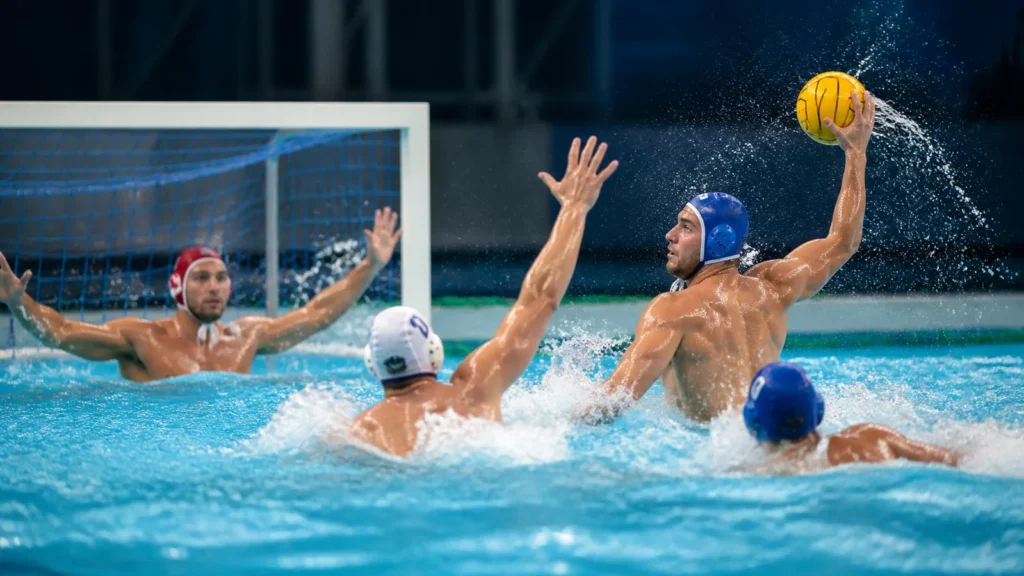
Water polo is an aquatic team sport in which two teams try to move the whole ball across the opponent's goal line. Official matches are governed by effective playing time, possession limits, ordinary fouls, exclusion fouls and penalty fouls. This guide gives players, coaches and pool managers a practical overview.
How is a water polo match structured?
A standard match uses four eight-minute periods of effective playing time. The match clock stops when the referee stops play. Breaks, tie-breaking procedures and age-group variations depend on the competition regulations.
- Players in the water: each team starts with seven players, including one goalkeeper.
- Team list: World Aquatics competition regulations allow up to fourteen eligible players, made up of twelve field players and two goalkeepers.
- Substitutions: players must leave and enter through an authorised re-entry or substitution area.
- Goalkeeper option: after the start, a team may use seven field players without a designated goalkeeper in the water.
Field dimensions and possession time
The updated World Aquatics field of play for men's and women's matches is 25.60 by 20.0 metres. Poolside markings identify the goal area, halfway line, re-entry areas and other referee reference points.
The attacking team must complete a valid attacking action before its possession expires. The current maximum is 25 seconds for men and 30 seconds for women. The clock is reset or adjusted after events defined in the full competition regulations.
When does a goal count?
A goal is awarded when the whole ball passes completely across the goal line between the posts and beneath the crossbar. The restart, location of a foul and correct method of putting the ball into play can affect whether a following shot is valid.
Ordinary, exclusion and penalty fouls
Ordinary fouls
Examples include taking the ball underwater when tackled, touching it with two hands when the goalkeeper exception does not apply, pushing off pool structures and illegally impeding an opponent. The usual sanction is a free throw.
Exclusion fouls
Holding, sinking or pulling back an opponent who is not holding the ball, materially preventing an attacking movement, or committing more serious misconduct can lead to temporary exclusion or a stronger sanction. The excluded player must move to the team's re-entry area without interfering with play.
Penalty fouls
A referee may award a penalty when an offence in a critical area prevents a probable goal or when another specified penalty offence occurs. Other players must respect the required position and distance until the throw is taken.
Restarts and advantage
Play can restart with a free throw, goal throw, corner throw, neutral throw or penalty throw. The ball must be put into play from the correct location and in the required manner. Referees may also preserve advantage when stopping play would disadvantage the attacking team.
Important updates for coaches
World Aquatics updates also provide a coach's challenge for specific referee decisions, including defined violent-action and penalty situations and certain field-of-play situations not reviewed by video technology. Availability and procedure depend on the competition and its technical facilities.
Pool equipment checklist
- Two stable water polo goals suitable for a wet and chlorinated environment
- Appropriate match and training balls
- Team caps and clearly identifiable goalkeeper caps
- Visible field markings and re-entry areas
- Match clock, possession clocks and scoreboard
- Safe bench, officials' table and substitution space
- Pre-match inspection of goals, nets, connections, edges and access routes
Frequently asked questions
Can a field player hold the ball with two hands?
Field players normally cannot touch the ball with both hands at once. The goalkeeper has defined exceptions within the permitted area.
Are the rules identical in every competition?
The main principles are shared, but age group, competition level, 4x4 formats and organiser regulations can introduce variations. The current rules for the specific event remain the final authority.
What information is needed to specify water polo equipment?
Provide pool dimensions, water depth, training or competition level, pool-edge construction, goal location, storage requirements and site photographs.
Rules note: this is a simplified educational guide, not a substitute for the complete regulations. It reflects the February 2026 World Aquatics Competition Regulations and the official water polo update notice.



Please sign in to leave a comment.