
Volleyball Rules: Complete Guide to Scoring, Rotation and Faults (2025–2028)
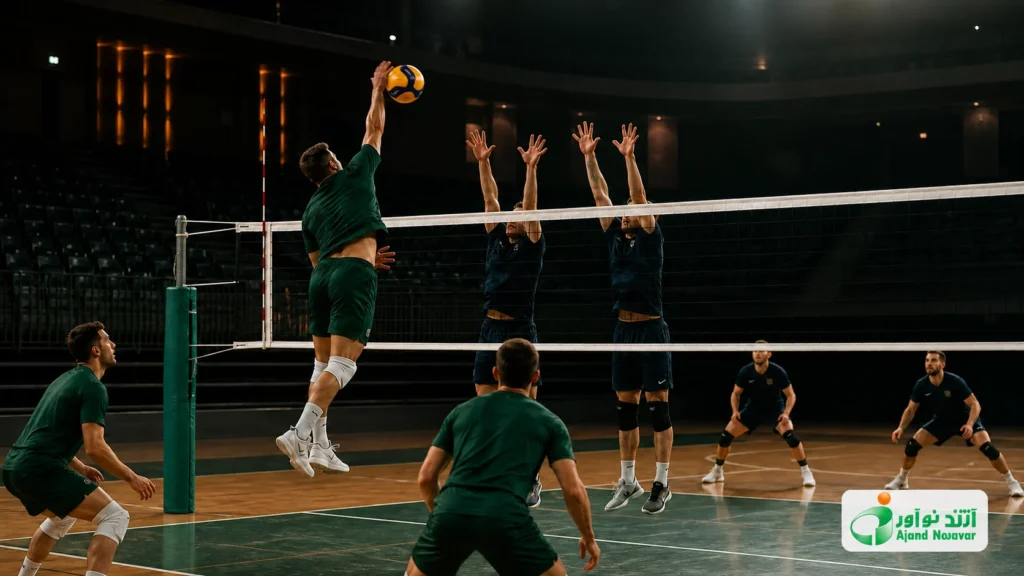
Indoor volleyball is played by two teams of six, using rally scoring, clockwise rotation and a maximum of three team hits to return the ball. A standard match is won by the first team to take three sets. Sets one to four are played to 25 points and a deciding fifth set to 15, always with a minimum two-point lead.
Volleyball rules at a glance
- Players on court: six per team, with three front-row and three back-row players.
- Winning the match: the first team to win three sets.
- Set score: 25 points in sets one to four and 15 in the fifth, with a two-point lead.
- Team hits: up to three contacts after receiving the ball, in addition to a block contact.
- Rotation: the receiving team rotates one position clockwise when it wins the right to serve.
- Ball on a line: the ball is in if any part of it touches a boundary line.
Court dimensions and net height
The official playing court is an 18 × 9 metre rectangle divided into two 9 × 9 metre halves. In each half, the attack line is drawn three metres back from the centre-line axis. Court lines are 5 cm wide and are included in the area they define.
A free zone at least three metres wide surrounds the court under the general rules, with at least seven metres of unobstructed space above the playing surface. FIVB World and Official Competitions require greater clearances. The playing surface must be flat, uniform and free from slipping or injury hazards.
The top of the net is 2.43 metres for senior men and 2.24 metres for senior women, measured at the centre of the court. The net is one metre wide and 9.5 to 10 metres long. Youth and domestic competition heights may differ, so confirm the organiser's rules before installation. See the volleyball net, post, antenna and referee-stand guide for equipment planning.
Scoring and sets
Every rally produces a point. A team scores by grounding the ball on the opponent's court, when the opponent commits a fault, or when the opponent receives a penalty. A set is won at 25 points with a two-point lead. At 24–24, play continues until one team leads by two. If the match reaches 2–2 in sets, the fifth set is played to 15 with the same two-point requirement.
How service works
The back-right player serves from behind the end line. The ball is hit with one hand or any part of the arm after being tossed or released; only one toss or release is allowed. The server has eight seconds after the first referee's whistle. At contact or take-off for a jump serve, the server must not touch the court, including the end line, or the floor outside the service zone. Landing inside the court after contact is permitted. A served ball that touches the net and crosses legally remains in play.
Rotation and player positions
Front-row positions are 4 (left), 3 (centre) and 2 (right); back-row positions are 5 (left), 6 (centre) and 1 (right). When the receiving team wins a rally, it gains service and rotates clockwise. Under the 2025–2028 rules, the receiving team must be in its rotational order at the service hit. The serving team's players, other than the server, may occupy any position within their court at that moment. After service contact, both teams can move into their tactical positions.
The three-hit rule
A team has no more than three hits to return the ball. A block contact is not counted, so three further hits remain available and the blocker may take the first of them. The ball may touch any part of the body but must rebound rather than be caught or thrown. Four hits, an assisted hit, a catch and an illegal double contact are common ball-handling faults. At a team's first hit, consecutive contacts with different body parts can be legal if they occur during one action.
Ball in, ball out and crossing the net
The ball is in when any part touches the court or a boundary line. It is out if it lands completely outside the lines, touches an outside object or non-player, contacts an antenna, or crosses the net outside the legal crossing space. The ball may touch the net while crossing. A ball driven into the net can be recovered within the team's three hits.
Net contact and the centre line
Contact with the net between the antennae during the action of playing the ball—from take-off through the attempt and safe landing—is a fault. Using the net for support, holding it or hindering an opponent is also a fault. Incidental contact outside an antenna is not necessarily a fault if it does not interfere with play.
Penetration under the net is allowed only without interference. A foot may touch the opponent's court if part of it remains on or directly above the centre line and the action does not interfere. A complete foot crossing or any penetration that obstructs the opponent is a fault.
Attack and block restrictions
A back-row player can complete an attack above net height only after taking off from behind the attack line; landing in the front zone afterwards is allowed. No player may complete an attack on the opponent's service while the ball is in the front zone and entirely above the net. Only front-row players may complete a block, and blocking the opponent's service is forbidden.
The Libero
A team may designate up to two defensive specialists as Liberos, although only one can be on court at a time. The Libero wears a clearly contrasting uniform and replaces back-row players.
- The Libero may not serve, block or attempt to block under FIVB rules.
- The Libero cannot complete an attack when the ball is entirely above the net.
- If the Libero uses an overhand finger pass in the front zone, a team-mate cannot complete an attack on that ball entirely above net height.
- Libero replacements are unlimited and do not count as regular substitutions, but a completed rally is normally required between replacements.
Time-outs and substitutions
Each team may request up to two time-outs and six regular substitutions per set. Requested time-outs last 30 seconds, unless FIVB approves an event-specific adjustment. A starting player may leave once and re-enter once per set, only to the original line-up position, with corresponding limits for the substitute. Libero replacements are separate from these six substitutions.
Cards and misconduct
Minor misconduct is managed first by a verbal warning and then a yellow card; the yellow card itself is not a point penalty. A red-card penalty gives the opponent one point and service. Red and yellow cards shown together mean expulsion for the rest of the set; shown separately, they mean disqualification for the rest of the match.
Common beginner mistakes
- Missing the clockwise rotation after gaining service
- Using four team hits or an illegal consecutive contact
- Catching or carrying the ball
- Touching the end line during service
- Touching the net during an action to play the ball
- A back-row attack from in front of the three-metre line on a ball entirely above the net
- A completed block by a back-row player or the Libero
Volleyball court preparation checklist
- Measure the 18 × 9 metre court, 5 cm lines and attack-line distance.
- Check net height at the centre and over both sidelines.
- Inspect net tension, side bands and antenna positions.
- Verify post stability and correctly fitted protective padding.
- Keep the surface, free zone and player routes dry and unobstructed.
- Check match balls, scoreboard, team seating and referee stand before play.
Frequently asked questions
How many points are in a volleyball set?
Sets one to four are played to 25 and the fifth to 15. A team must lead by two points, so a set can continue beyond its target score.
How many times may a team touch the ball?
A team has three hits to return the ball. A block contact is not included and gives the team three further hits.
Is a serve that touches the net a fault?
No. Play continues if the ball touches the net and crosses through the legal space. It is a fault if it does not cross legally or goes out.
Is every touch of the net a fault?
No. A touch between the antennae during an action to play the ball, or contact that interferes or creates an unfair advantage, is a fault. Incidental contact outside the antennae is not automatically a fault.
Do youth and school volleyball use the same rules?
The playing principles are shared, but net height, team format, set format and substitution rules may be adapted. The regulations for the specific competition are authoritative.
Rules note: this is a simplified educational guide and does not replace the complete competition regulations. The primary reference is the official FIVB Volleyball Rules 2025–2028; domestic competition regulations should also be checked.





Please sign in to leave a comment.