
Basketball Rules: FIBA Guide to Scoring, Fouls and Court Setup
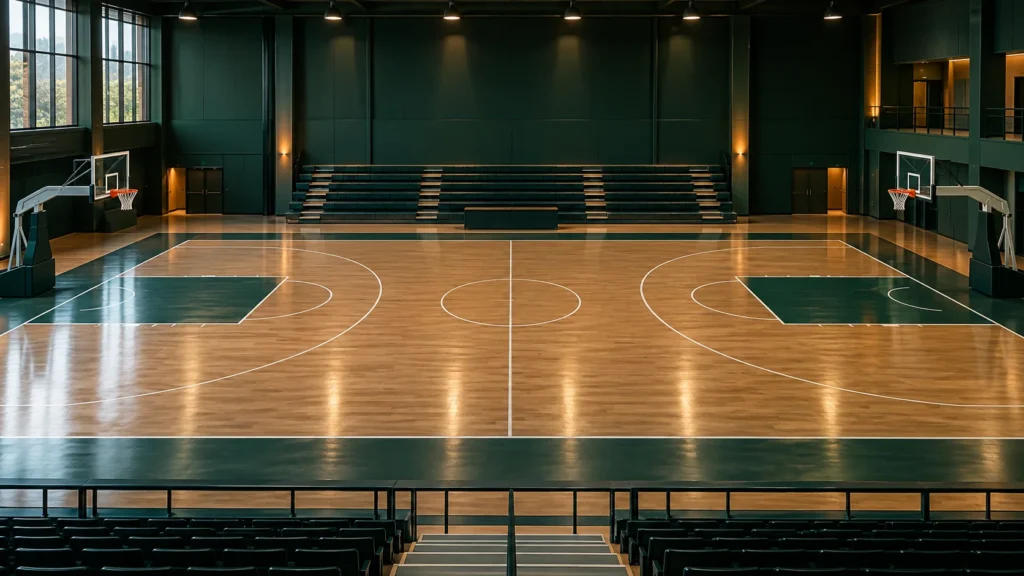
Five-player basketball is played by two teams of five under the FIBA rules. Each team seeks to score in its opponent's basket while preventing the other team from scoring. This guide explains the main playing rules and the basic court and equipment requirements.
Basketball rules at a glance
- Players: five from each team on court.
- Playing time: four 10-minute quarters of effective time; five-minute overtimes break a tie.
- Scoring: one, two or three points depending on the shot.
- Time limits: 24 seconds to attempt a shot, eight seconds to reach the frontcourt and a restricted three-second period for an attacker in the opponents' restricted area.
- Fouls: a player must leave after five recorded personal or technical fouls; a team enters the team-foul penalty situation after four team fouls in a quarter.
Playing time and scoring
Each quarter lasts 10 minutes of playing time, with the game clock stopped for prescribed interruptions. Half-time lasts 15 minutes. If the score is tied after the fourth quarter, five-minute overtimes continue until there is a winner.
A successful free throw counts one point. A field goal from the two-point area counts two, and a field goal from the three-point area counts three. The three-point line itself belongs to the two-point area: a shot released with a foot on the line counts two points.
Court dimensions and the basket
A regulation FIBA court is 28 × 15 metres. The curved three-point line has a radius of 6.75 metres measured from the basket centre and joins straight segments near the corners. The top of the ring is 3.05 metres above the floor. Court preparation also calls for appropriate free space, flooring, lighting, backstops, protective padding and timing equipment.
Equipment requirements depend on the competition level. Confirm the organiser's specifications before purchasing or installing a system. Our sports hall padding guide helps identify impact zones.
The 24-second, eight-second and three-second rules
A team controlling the ball must attempt a shot within 24 seconds. The ball must leave the shooter's hand before the signal and then touch the ring or enter the basket. After an offensive rebound in the specified circumstances, the shot clock is generally set to 14 seconds; a stoppage does not always produce a fresh 24 seconds.
A team controlling the ball in its backcourt must advance it to the frontcourt within eight seconds. An attacker may not remain in the opponents' restricted area for more than three consecutive seconds while their team controls a live ball in the frontcourt and the game clock is running, subject to the exceptions in the full rules.
Dribbling, travelling and backcourt violations
Players may move with the ball by dribbling. Beginning a new dribble after ending one, without losing control, is an illegal double dribble. Foot movement after gaining control must respect the pivot and step rules; extra movement is travelling. The exact count depends on when control is gained and the position of the feet.
Once a team has established control in its frontcourt, it may not illegally cause the ball to return to its backcourt and be the first team to touch it there.
Personal fouls, team fouls and free throws
Illegal contact that impedes an opponent, such as holding or pushing, may be a personal foul. Not every contact is a foul; the referee considers legal position and the effect of contact. A player who has committed five fouls must leave the game.
After four team fouls in a quarter, later personal fouls on a player who is not shooting normally result in two free throws, except for a foul by the team in control of the ball. A foul on a shooter can lead to one, two or three free throws depending on whether the shot went in and where it was taken. Technical, unsportsmanlike and disqualifying fouls have separate penalties.
Out-of-bounds, game start and substitutions
The ball is out when it or the player holding it touches a boundary line or an area outside the court. The opponents normally receive a throw-in. The game begins with a jump ball in the centre circle; many later jump-ball situations use alternating possession and its direction arrow.
Each team has two time-outs in the first half, three in the second half and one in each overtime. Each time-out lasts one minute. Substitutions and time-out requests must be made through the scorer's table during a legal opportunity.
Pre-game venue checklist
- Confirm court dimensions, markings, basket position and installation level.
- Inspect the stability of backstops, boards, rings, nets and padding.
- Keep the floor dry and the area around the court clear.
- Test the game clock, shot clocks, signals, scoreboard and alternating-possession arrow.
- Check the competition level and any additional federation or organiser requirements.
Frequently asked questions
How long is a FIBA basketball game?
It has 40 minutes of effective playing time in four 10-minute quarters. Stoppages and intervals make the elapsed event longer.
How many fouls can a player commit?
After a fifth recorded personal or technical foul, the player must leave and be replaced.
Are NBA and FIBA rules the same?
No. Game length, court dimensions and some officiating details differ. This guide covers FIBA five-player basketball, rather than NBA or 3x3 rules.
Rules note: this is a simplified educational guide. At publication, the FIBA Official Basketball Rules 2024 and Basketball Equipment document are in force. The 2026 edition takes effect on 1 October 2026. Check domestic federation and event regulations as well.
Please sign in to leave a comment.